CrossFit Lingo 101:
What everyone is saying in our Gym
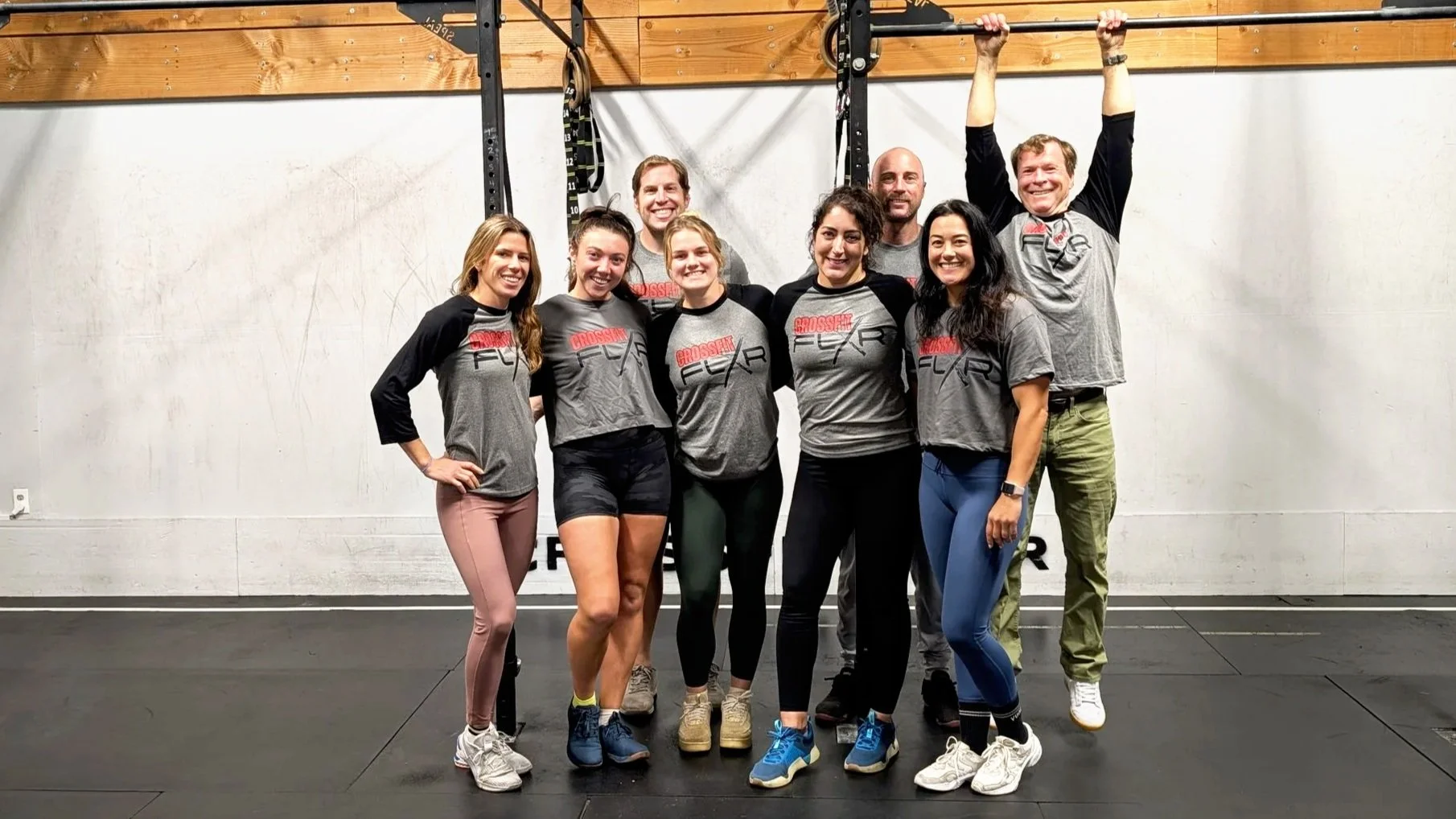
Walking into your first CrossFit fitness class can feel like stepping into a room where everyone speaks a different language.
You hear things like:
“Today’s WOD is a 12-minute AMRAP with toes to bar and an EMOM finisher.”
And you’re thinking…
“I just wanted a workout.”
If you’re new, take a breath. Every experienced athlete once stood exactly where you are, confused by acronyms, unsure what movements meant, and wondering if everyone else had some secret decoder.
They don’t.
CrossFit just has its own vocabulary.
This guide will help you walk into class feeling confident and no prior knowledge required!
First Things First: What Is a WOD?
WOD stands for “Workout of the Day.”
Each day, the gym programs a specific workout for everyone to complete. It might focus on strength, conditioning, gymnastics skills, Olympic lifting, or a mix of everything.
When someone asks, “How was the WOD?” they’re simply asking how the workout went.
Nothing mysterious. Just gym shorthand.
The Big Three Workout Formats
These are the formats you’ll hear most often.
AMRAP: “As Many Rounds (or Reps) As Possible”
You’re given a time cap of 8, 10, 15, or even 20 minutes, and you repeat a set of movements as many times as possible before time runs out.
Example:
10-minute AMRAP
• 10 air squats
• 10 push-ups
• 10 sit-ups
You keep cycling through those movements for 10 minutes and count how many rounds you complete.
It’s about pacing and consistency, not sprinting out of the gate.
EMOM — “Every Minute On the Minute”
At the start of each minute, you complete a set amount of work. Whatever time is left becomes your rest.
Example:
EMOM 8 minutes
• 5 deadlifts
If the 5 deadlifts take you 20 seconds, you get 40 seconds to rest before the next minute begins.
EMOMs are great for building strength, power, and discipline because you must manage your effort.
For Time
This one is straightforward.
You complete the assigned workout as fast as possible, with good form, and record your time.
Example:
21-15-9
• Thrusters
• Pull-ups
You finish 21 reps of each movement, then 15 of each, then 9 of each. When you finish the final rep, you stop the clock.
Speed matters! But safe, solid movement matters more.
Common Movement Abbreviations (The Decoder List)
Here’s where things can feel intimidating. Let’s simplify it.
TTB = Toes to Bar
DU = Double Unders (jump rope passes twice per jump)
SU = Single Unders
HSPU = Handstand Push-Up
KB = Kettlebell
DB = Dumbbell
BB = Barbell
FS = Front Squat
BS = Back Squat
DL = Deadlift
PC = Power Clean
HPC = Hang Power Clean
OHS = Overhead Squat
If you don’t know a movement, that’s completely normal.
Every class includes explanation and demonstration. Coaches break down technique, scaling options, and safety cues before the workout starts.
You are never expected to “just know.”
RX vs. Scaled — And Why Scaling Is Smart
You may see “RX” written on the board.
RX means performing the workout exactly as written, using the listed weight amount and movements.
Scaled means modifying the workout to match your current fitness level.
And here’s something important:
Scaling is not a downgrade.
It’s intelligent training.
If a workout includes pull-ups and you’re still building strength, you might use a resistance band on the rig to pull up or you can do ring rows.
If the prescribed weight feels unsafe or too heavy, you can lower it.
The goal is stimulus, meaning the workout should feel challenging, regardless of the version you’re doing.
Even experienced athletes scale regularly!
PR — Personal Record
A PR is a personal best.
It might be:
The heaviest deadlift you’ve ever lifted
Your first unassisted pull-up
A faster mile time
A heavier kettlebell than last month
PRs don’t have to look dramatic to matter.
Progress is personal.
What Happens in a Typical Class?
Understanding the flow helps calm nerves.
Most classes follow this structure:
Warm-Up – Light cardio and mobility work to prepare your body
Skill or Strength Portion – Practicing a lift or movement
The WOD – The main workout
Cool Down – Stretching or mobility work
You’re guided through each section. No guessing required.
Words You’ll Hear Often
Box – A nickname for a CrossFit gym.
Whiteboard – Where workouts and scores are written.
Time Cap – The maximum amount of time allowed to finish a workout.
Chipper – A longer workout with many movements performed once through.
MetCon – Short for metabolic conditioning (a conditioning-focused workout).
The more you attend, the more natural these words feel.
What Beginners Worry About (And What’s Actually True)
“Everyone will be watching me.”
They won’t. Most people are too focused on their own workout.
“I’m not fit enough yet.”
You don’t get fit before you start. You start, and then you get fit.
“I’ll hold the class back.”
Classes are designed for mixed ability levels. Everyone moves at their own pace.
“I don’t know the movements.”
That’s why coaching exists.
Every strong athlete started as a beginner.
What Actually Matters in Your First 90 Days
It’s not:
Doing workouts RX
Lifting the heaviest weight
Finishing first
Memorizing all the acronyms
It’s:
Showing up consistently
Learning proper mechanics
Listening to coaching cues
Building confidence
Recovering well
Fitness is a skill.
And skills take repetition.
A Sample Beginner Workout Breakdown
Let’s say the workout says:
12-minute AMRAP
• 200m run
• 10 kettlebell swings
• 8 push-ups
As a beginner, you might:
Walk or lightly jog the run or bring out a bike or rower
Use a lighter kettlebell
Perform push-ups on a box or your knees
You still get the same conditioning benefit.
You still build strength.
You still improve.
That’s how CrossFit stays accessible.
You Don’t Need to Know Everything to Start
Nobody expects you to walk in knowing what to do.
You just need to walk in willing.
Ask questions.
Introduce yourself.
Stay curious.
Focus on effort over perfection.
Within a few weeks, you’ll catch yourself saying:
“That EMOM was tough.”
“I almost PR’d my front squat.”
“My double unders are improving.”
And one day, you’ll be the one explaining what AMRAP means to someone new.
That’s how this community works.
If you’re new and feeling unsure, come try a class. We’ll guide you through every step, no secret language required.
And if you ever forget what something means?
Just ask.
We promise we don’t bite. 💪 We offer a Foundations class for people who are new to the CrossFit community, or if you haven't done CrossFit in a while and are feeling a little rusty! Our coaches break down the movements so you can walk into your first class feeling more confident! If that is something you're interested in click the link below!!
